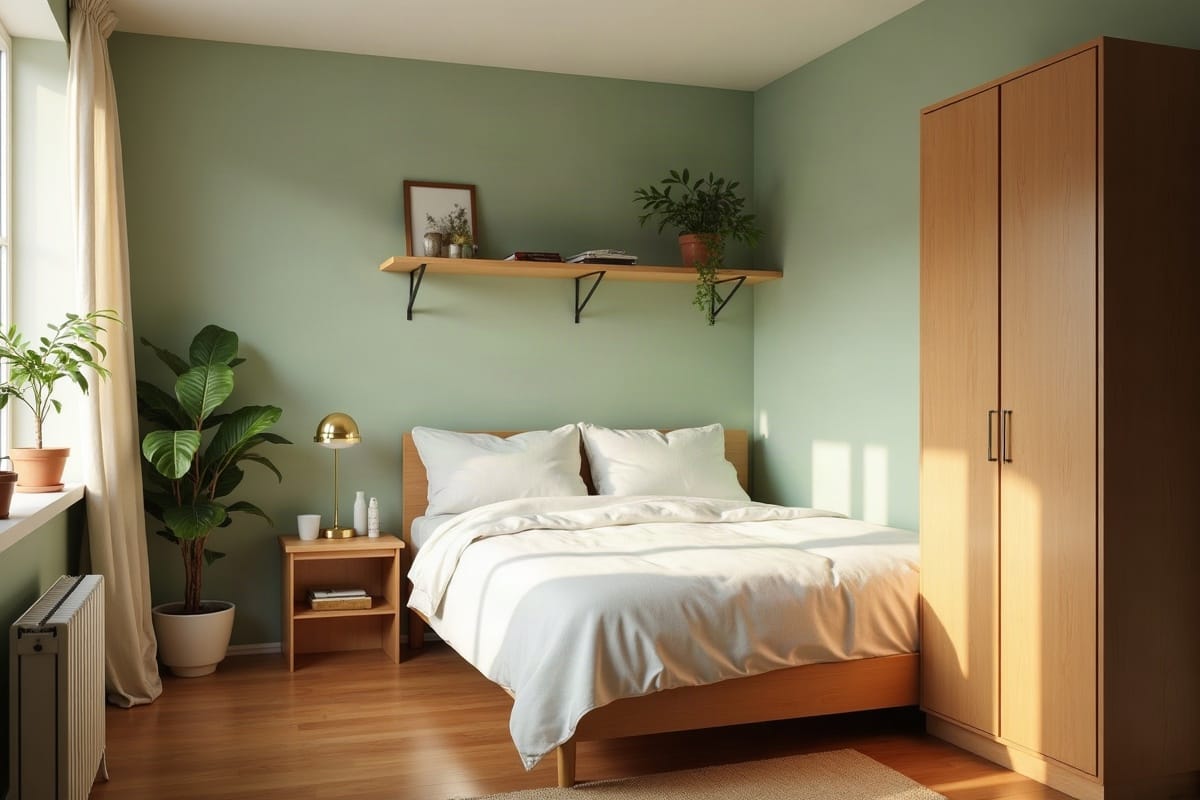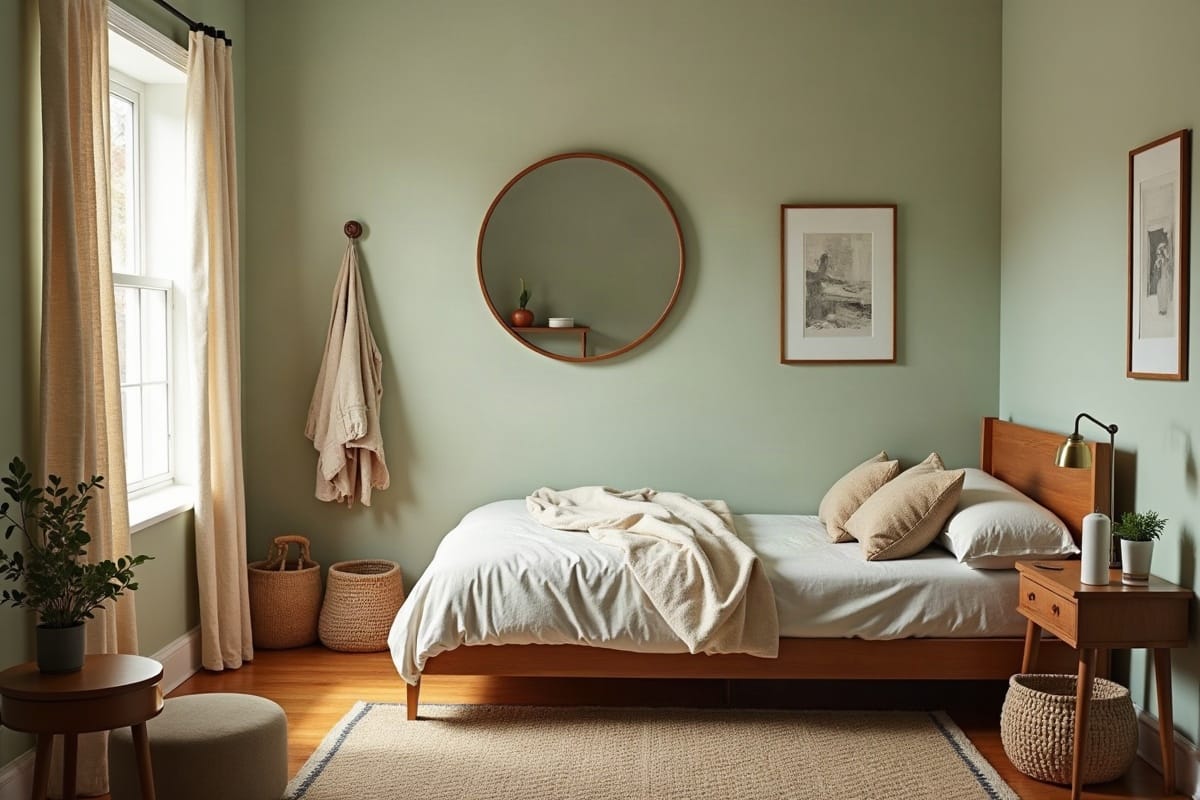
A small bedroom rarely needs new furniture; it needs the furniture it already has in better places. Each of these nine changes moves, hangs, or paints something you own, with the measurement that makes it work, because "add a mirror" is not a plan.
Every one comes out of a rental: screws fill, paint repaints, baskets leave with you.
Why this plan works
- Every idea states where it goes, how high, and what it costs.
- Costs are hardware and a quart of paint; with a full hardware drawer the number is zero. The priciest is about $45.
- All nine come out of a rental with a putty knife.
- The order at the end ranks them by what you get per hour. One an hour, not all in one weekend.
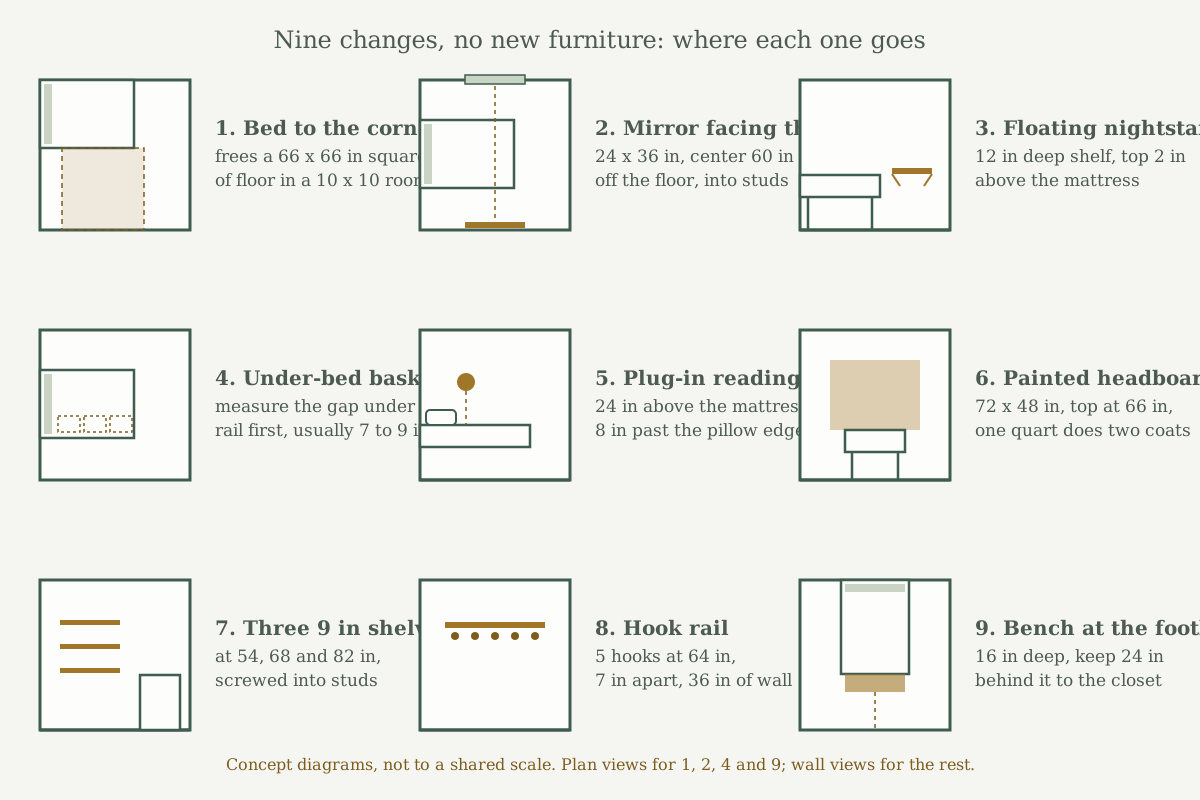
1. Push the bed into a corner
The single biggest change and it costs nothing. In a 10 x 10 room a full bed centered on a wall leaves two 33-inch strips you can walk but not use.
The same bed in a corner leaves a 66 x 66 inch square of floor in one piece, 30 square feet, and a 45-inch zone at the foot for the dresser. We drew all three versions to scale in the 10x10 bedroom plan, with a what-still-fits table for each.
- Leave 2 inches between the mattress and the wall so the sheets have somewhere to tuck.
- The wall-side sleeper climbs over. For two people, the plan above has the two-sided version and what it costs in floor.
- Rental exit: none needed. Cost: $0.
2. Hang the mirror on the wall facing the window
Not beside the window, facing it. The mirror throws the window's light at the back of the room, and from the door it reads as a second window.
- Size: 24 x 36 inches, long side vertical.
- Height: center at 60 inches off the floor. That's standing eye level for most adults, with the bottom edge at 42 inches, above a dresser or a bed.
- Weight: a mirror that size runs 15 to 25 pounds. Two hooks 16 inches apart into studs, or two anchors rated 50 pounds each. Never a single nail.
- Rental exit: two holes and a thumb of filler. Cost: $0 with the mirror you own, $4 for the hooks.
3. Float the nightstand
A nightstand takes 22 x 18 inches of floor and holds a lamp, a glass, and a book. A 12-inch-deep shelf, 18 to 20 inches wide, holds the same three things on zero floor.
- Height: top 1 to 2 inches above the mattress top. On most beds that's 24 to 28 inches off the floor; measure yours, don't guess.
- Two brackets, one into a stud. Studs run at 16-inch centers, so a 20-inch shelf always catches at least one.
- Load: what a nightstand holds. Brackets rated 20 pounds are plenty.
- The freed floor means the bed slides 6 inches further into the corner, or the strip beside it becomes a real path.
- Rental exit: four screw holes. Cost: $15 to $30 for a board and brackets.
4. Baskets under the bed, measured first
Measure from the floor to the underside of the bed's side rail, not to the bottom slat. The rail is what a basket has to clear.
Most frames give 7 to 9 inches; a 6-inch-tall basket slides under that with an inch to spare, and anything taller catches on the rail every time you pull it.
- Baskets: 12 x 24 inches, three per side under a 75-inch bed (three 24s are 72). Off-season clothes and spare bedding.
- Put what you use least at the head end, where you have to lift the bedskirt to reach.
- Gap under 6 inches: bed risers add 3 to 5 inches for about $15 a set, the only purchase here that is close to furniture.
- Rental exit: none. Cost: $0 with baskets you own, about $10 each otherwise.
5. A plug-in reading light instead of a lamp
Take the lamp off the nightstand and put the light on the wall. It lights a page without lighting your face.
- Height: sconce center 24 inches above the mattress top, and 6 to 10 inches outside the pillow's edge. On a 24-inch-tall mattress that's 48 inches off the floor.
- Cord: down a paintable cord cover ($6) to the nearest outlet.
- Plug-in only. Hardwiring a sconce means opening a wall box, and that is licensed-electrician work; the line is at the box, not at the wall.
- Rental exit: two screws, and the cord cover peels. Cost: $25 to $40 for the sconce and cover.
6. Paint a headboard block
No headboard? Paint one. A block 72 inches wide and 48 inches tall, centered on the bed, bottom at 18 inches (a standard frame height), top at 66.
That is 9 inches wider than a 54-inch full bed on each side, which is what makes it read as a headboard instead of a stripe.
- The math: 72 x 48 is 24 square feet, 48 with two coats. A quart covers about 100, so one quart does it with touch-up left over.
- Tape the edges with 1-inch painter's tape and pull the tape while the second coat is still damp; it stays crisp.
- Lease says no paint at all: a peel-and-stick panel in the same size does the same job for about $40.
- Rental exit: one quart of the wall color paints it back. Cost: $20 to $25 for a quart and tape.
7. Three shallow shelves instead of a bookcase
A bookcase is 12 inches deep, and in a 33-inch strip beside a bed that leaves 21 inches of path, which fails the 24-inch minimum. Three 9-inch-deep shelves on the same wall leave exactly 24.
It's the trade we made in Layout 3 of the 10x10 plan.
- Heights: 54, 68 and 82 inches. The lowest sits above a 36-inch dresser with reach room, the 14-inch gaps take books upright or a plant, the top stays within arm's reach once it's up.
- Width: 30 to 36 inches, so each shelf catches two studs.
- Brackets into the studs, never drywall anchors; books are heavier than they look.
- The top bracket at 82 inches is a step-stool job: both feet on the stool, never on the bed.
- Rental exit: six holes. Cost: $20 to $45 for boards and brackets, $0 if you're cutting down shelving you own.
8. A hook rail at 64 inches
Five hooks, 7 inches apart, on a 36-inch rail with its hooks at 64 inches off the floor. At 64, a 48-inch coat ends 16 inches above the floor and clears anything underneath except a dresser.
- Wall: one with nothing under it. The 36 inches beside the closet, or the strip between closet and corner. Never the wall the door opens against; hooks there stop the door.
- The same rail beside the front door, with a seat under it, is the 3-foot entryway drop zone, where the hooks move up to 66 because of the seat.
- Every wall spoken for: an over-the-door rail holds the same five things with no holes at all.
- Rental exit: two to four screws, or none. Cost: $0 with a rail you own, $15 otherwise.
9. A bench at the footboard
A dining bench, a trunk, a blanket chest, whatever you already have that's about 16 inches deep and no taller than the mattress top. It sits at the foot of the bed: a place to put shoes on, a place for tomorrow's clothes.
- The rule: keep 24 inches behind it to the wall or closet, 30 if that's where you dress.
- In a 10 x 10 room that only happens with the bed centered under the window, Layout 3 in the bedroom plan, where the bench keeps 29 inches to the closet and clears the door's arc by 10.
- In a corner layout the bench lands 11 inches from the dresser. Skip it there.
- Rental exit: none. Cost: $0.
In what order
Ranked by what you get per hour, not per dollar, because most of these cost nothing:
- The corner bed (idea 1). Twenty minutes, the largest change in the room.
- Baskets under the bed (idea 4). Measure, slide, done.
- The mirror facing the window (idea 2). One evening of light for two holes.
- The reading light (idea 5). It frees the nightstand, which lets you float it.
- The floating nightstand (idea 3).
- Shelves, then the hook rail (ideas 7 and 8). Same drill, same afternoon.
- The bench (idea 9), only if your layout has the 24 inches.
- The painted block (idea 6). Last, because you'll know where the bed lives for good by then.
Copy this plan
| Item | Where it goes | ~Price |
|---|---|---|
| Bed | The corner, 2 in off the wall on the wall side | $0 (own it) |
| Mirror, 24 x 36 in | Wall facing the window, center at 60 in, two hooks into studs | $0 (own it), $4 hooks |
| Shelf, 12 x 20 in, and 2 brackets | Head end, top 1 to 2 in above the mattress | $25 |
| Baskets, 12 x 24 x 6 in, up to six | Under the side rails, least-used at the head end | $0 (own them), or $10 each |
| Plug-in sconce and cord cover | 24 in above the mattress, 6 to 10 in past the pillow | $35 |
| Quart of paint and 1-in tape | 72 x 48 in block, top at 66 in | $25 |
| Three boards, 9 x 36 in, and 6 brackets | 54, 68 and 82 in, into studs | $45 |
| Hook rail, 36 in | Hooks at 64 in on a wall with nothing under it | $15 |
| Bench | Foot of the bed, 24 in kept behind it | $0 (own it) |
| Total | $0 with what you own; about $210 buying every piece of hardware new |
The bedroom is the easiest room in the house to fix with a tape measure, because the bed decides everything and it only goes three places. One idea after work tonight counts; the list will keep.
If the living room is next, the 10-foot living room plan and the corner fireplace plan run the same measure-first method on rooms with more pieces in them.