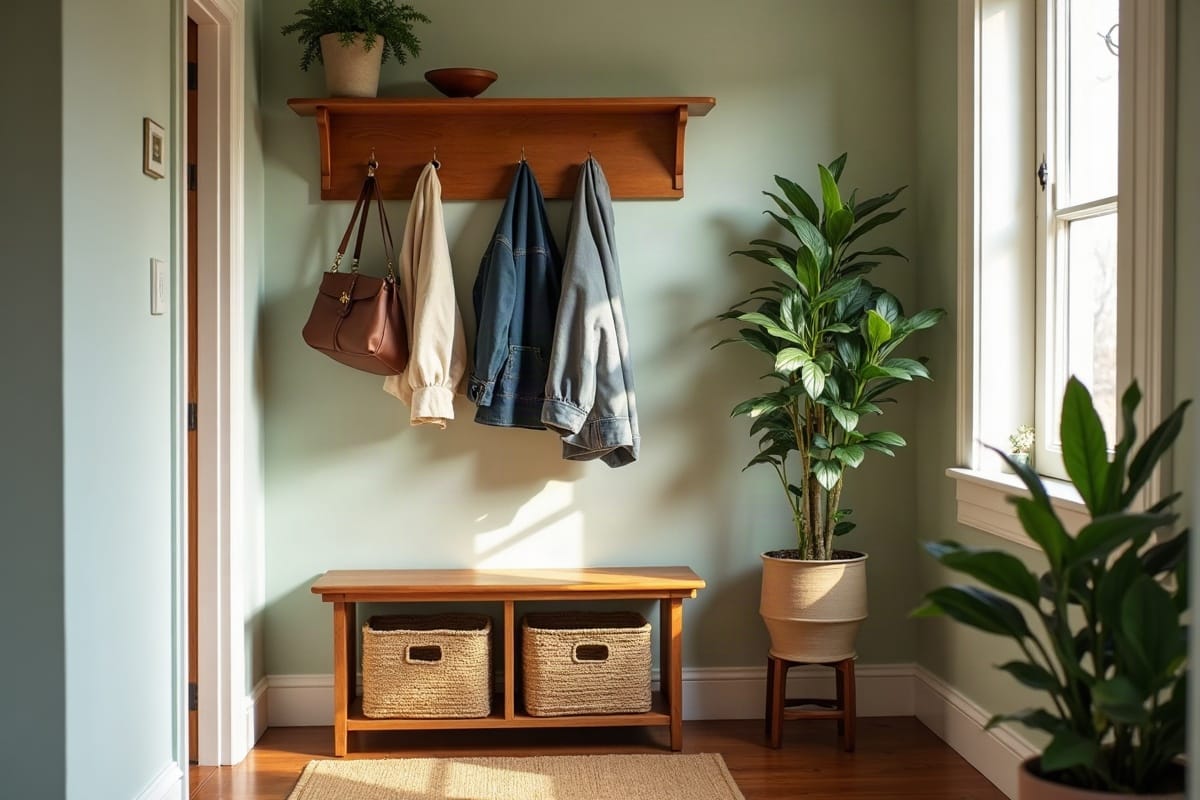
Coats and keys land on the first surface a hand can reach, every day, in every house. A drop zone works when that surface is built for the job, and this plan builds one in 36 inches of wall (91 cm).
What decides whether it gets used is not the hooks. It's where the wall is. This plan gives you:
- The placement rule that decides it.
- The exact heights for adults and for children, with the reasons behind them.
- The pieces ranked by what each dollar buys. Build it all in a weekend, or stop at $47 and still have a drop zone that works.
The heights come from stated standards, not from a room we measured: the 60-to-66 inch range that hook makers and planners use for coats, standard seat height, and overhead reach for a 5-foot adult. Where we moved a number off the standard, we say why.
Why this plan works
- The 3-foot rule puts the hooks where hands already are, so the system runs itself.
- Every height is stated with its reason, for adults and for children.
- The pieces are ranked by what each dollar buys, and the lean version is $47.
- Twelve screw holes total, counted, with the rental exit included.
The rule: within 3 feet of the door, or it fails
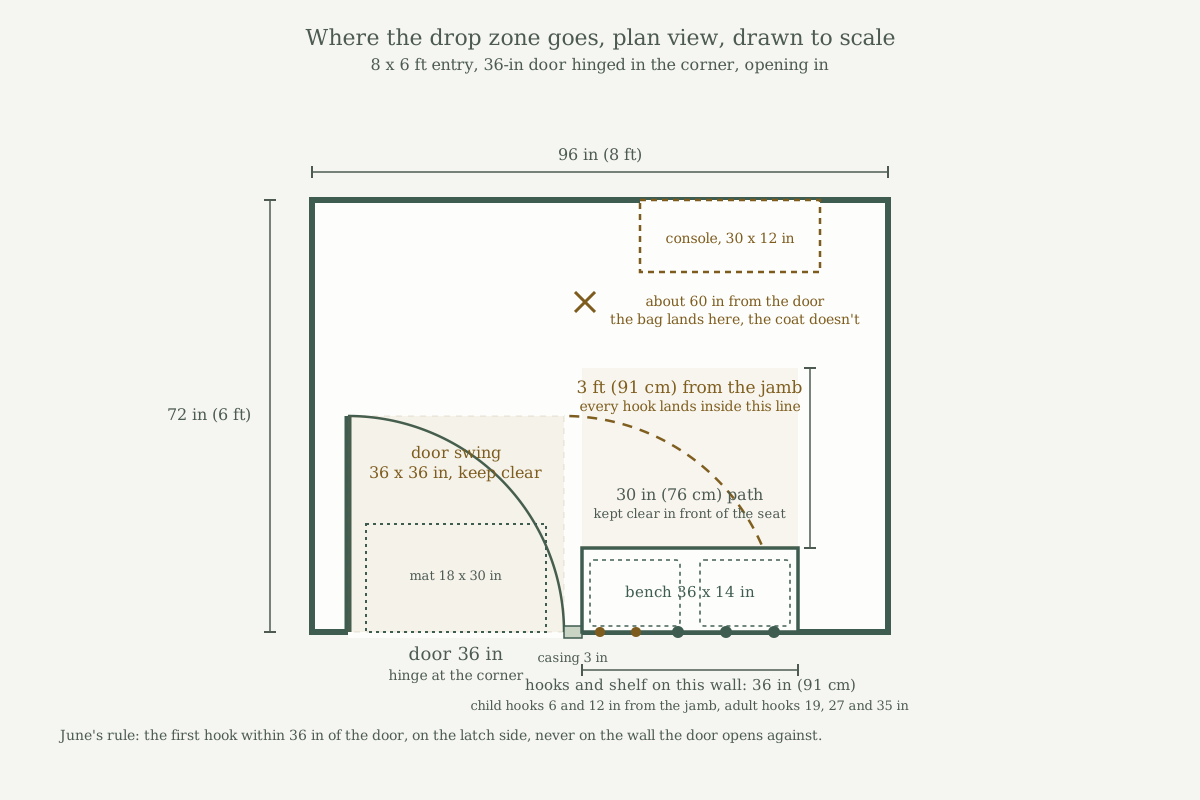
Everyone drops their things on the first surface they reach with a bag in one hand and keys in the other. That surface is about one stride inside the door, 36 inches.
Put the hooks there and the coats go on the hooks. Put a beautiful console 60 inches in and the bag lands on the console, the keys land beside it, and the coat lands on the nearest chair, every day, forever.
June's rule: the first hook goes within 36 inches of the door jamb, on the latch side, and never on the wall the door opens against.
It's the same rule that makes the pantry reset survive: things live where you stand when you use them, not where they'd look nice.
Why the latch side
The door's swing owns the other wall. A 36-inch door hinged in the corner sweeps a 36 x 36 in box, the same 9 square feet we keep clear in the bedroom plans, and hooks inside that box stop the door.
So the drop zone lives on the door's own wall, past the casing, or on the side wall the door swings away from, as long as the first hook is inside that 36-inch arc.
Measure your entry before you buy
Three numbers:
- The door width.
- The casing, usually 2 to 3 inches.
- The wall from the casing to the corner. You need 36 clear inches past the casing.
If you have 30, the plan still works with four hooks instead of five and a 30-inch bench. If you have 24, skip the bench and keep the hooks and the basket, because the hooks are the drop zone; everything else is comfort.
The heights, and why
| Element | Height from the floor | Why this number |
|---|---|---|
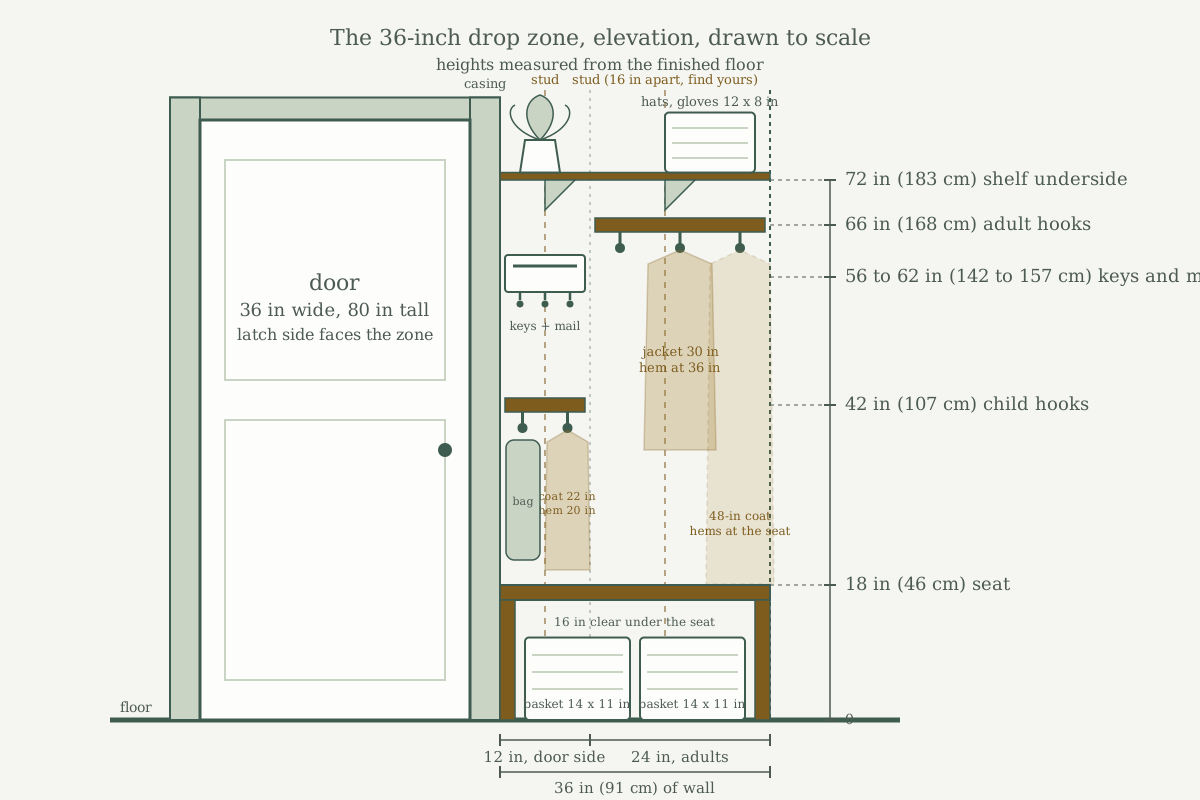
| Bench seat | 18 in (46 cm) | Standard seat height is 17 to 19 in. 14 in deep so it stays out of the path. |
| Baskets under the seat | 11 in tall in 16 in of clearance | Shoes and a bag go in at knee height without bending to the floor. |
| Child hooks | 42 in (107 cm) | A 4-year-old stands about 40 in and reaches about 48 in overhead. At 42, the hook is theirs from 4 until about 10. A 22-in child's coat hems at 20 in, 2 in above the seat. |
| Keys and mail | 56 to 62 in (142 to 157 cm) | Standing eye height for most adults. A pocket you look into as you pass is a pocket that gets emptied. |
| Adult hooks | 66 in (168 cm) | Hook makers say 60 to 66. We take the top of the range because a seat sits underneath: a 48-in coat hung at 66 hems at 18 in, exactly the seat, and a 30-in jacket at 36 in. Still under the 72-in comfortable overhead reach of a 5-foot adult. |
| Shelf underside | 72 in (183 cm) | 6 in of air above the hooks and the top of comfortable reach for a 5-foot adult. Households over 5 ft 8 can go to 78 and gain headroom. |
| Path in front of the seat | 30 in (76 cm) | The same main-path number as every small-room plan here. 24 works if you accept turning sideways with a laundry basket. |
The 66-inch number is the one to notice. The bedroom hook rail in our small-bedroom ideas sits at 64 because nothing sits under it.
Here the seat does, and a coat that puddles on the seat is a coat that gets moved to a chair. Two inches fix that.
Two columns on one wall
Split the 36 inches:
- The 12 inches nearest the door: the children and the keys. Two child hooks at 42 in, 6 in apart, with the key and mail rack above them at 56 to 62.
- The remaining 24 inches: the adults. Three hooks at 66 in, 8 in apart.
That puts the small coats at the door end, first off the wall in the morning. It also keeps the key rack out from under the adult coats, which hem at 36 in and would bury anything lower in the adult column.
The long-coat catch
A 48-in overcoat on the leftmost adult hook drapes over the child column. Hang long coats on the hook farthest from the door, or in the closet, and the two columns stay two columns.
No children in the house?
One 36-in rail with five hooks 7 in apart at 66, and the keys go in a bowl on the door end of the shelf. You'll drop them by feel at 73 in, which is fine, because the whole point is that they land in the same place every time.
What the shelf is for
The shelf runs the full 36 inches, 8 in deep, and holds what you look at and what's out of season: a 12 x 8 in basket for hats and gloves, a plant if the entry has a window.
It is not the key spot. Keys at 73 in are keys you can't see.
The pieces, ranked by what each dollar buys
- The hook rail, $20. This is the drop zone. Everything below is what makes it comfortable.
- The doormat, $15. 18 x 30 in, inside the door. It's where the shoes stop, which is why the baskets go next to it.
- Two baskets, $24. 14 x 10 x 11 in. On the floor under the hooks if there's no bench yet; they hold the shoes and the bag that would otherwise hold the floor.
- The key and mail rack, $15. A 12-in pocket with three hooks under it. The mail stops being a pile the day it has a slot.
- The shelf, $25. 36 x 8 in with two brackets. Hats, gloves, the dog's leash in a basket.
- The bench, $80. 36 x 14 x 18 in. The biggest number on the list and the last thing to buy, because the zone already works without it. Buy it used; a plain bench with 16 in of clearance under the seat is a plain bench at any price.
Stop after item 3 and you've spent $59 on a drop zone that does the job. Add the painter's tape and anchors and the honest number for the lean version is $47 if you already own a basket or two, $71 if you don't.
Prices vary; these are typical US retail ranges, rounded.
Fasteners, weight, and the rental exit
The rail takes the abuse
Five coats and two bags on a rail weigh 30 to 40 pounds, and someone yanks a coat off it every morning. Screw the rail into both studs.
- Studs run 16 inches apart, so 36 inches of wall usually crosses two. Find them before you tape anything.
- Where a stud isn't where a screw needs to be: a toggle anchor rated for 50 pounds, one per screw hole.
- Never a drywall plug on a coat rail.
The shelf goes into studs, no exceptions
It hangs above a head. Two brackets on the two studs, four screws.
Mounting it means standing on a step stool with both feet on the stool, not on the bench.
The bench and the hall tree
The bench is freestanding and 18 inches tall; it doesn't need a tip strap. If you buy a hall tree instead, the kind with a back panel and hooks that stands 70 inches, strap it to a stud, because a child will climb it.
The rental exit, counted
- Rail: 4 screws. Child rail: 2. Key rack: 2. Shelf: 4.
- Total: twelve holes, a thumb of spackle, one coat of touch-up.
If even that's too many, a freestanding hall tree 36 inches wide holds the same hooks and seat with zero holes, at $100 to $150, and the 3-foot rule still applies to where you stand it.
Copy this plan
| Item | Where it goes | ~Price |
|---|---|---|
| Hook rail, 24 in, 3 hooks | Adult column, 24 in farthest from the door, hooks at 66 in, screwed to both studs | $20 |
| Two single hooks | Child column, 12 in nearest the door, at 42 in, 6 in apart | $6 |
| Key and mail rack, 12 in | Child column, 56 to 62 in | $15 |
| Shelf, 36 x 8 in, two brackets | Full width, underside at 72 in, brackets into the studs | $25 |
| Bench, 36 x 14 x 18 in | Against the wall under the hooks, 30 in of path kept in front | $80, or $0 with a bench you own |
| Two baskets, 14 x 10 x 11 in | Under the seat, one for shoes, one for bags | $24 |
| Doormat, 18 x 30 in | Inside the door, between the door and the bench | $15 |
| Painter's tape and four 50-lb toggle anchors | The wall, before anything is drilled | $12 |
| Total | $197, or $117 with a bench you own |
The $47 version: the rail, the mat, the tape and anchors, and one basket you already own. Hooks at 66, basket on the floor under them, mat inside the door.
That's a drop zone. The rest is a better one.
The weekend, step by step
Steps 1 to 5 are Saturday morning and cost nothing. The drilling is Sunday.
1. Measure and write it down
Measure the door, the casing, and the wall from the casing to the corner. Write the three numbers on the tape roll.
2. Find the wall by walking in
Walk in the front door carrying a bag, keys, and a coat over your arm, and stop where your hand goes first. That's the wall. If it isn't within 36 inches of the jamb, the entry is telling you where the drop zone wants to be.
3. Mark the studs
Find them with a stud finder or a knuckle and mark them from floor to 78 in with a strip of painter's tape.
4. Tape the elevation on the wall
A horizontal strip at 66 in, one at 42, one at 72. Tape the bench footprint on the floor, 36 x 14, and the 30-inch path in front of it.
5. Live with the tape until evening
Hang a real coat from a strip of tape at 66 with a pin and see where it ends. Then buy, in the ranked order above, and stop when the budget says stop.
6. Rail first, into the studs
Level, into both studs or into toggle anchors where the studs miss. Pull on it hard before anything else goes up.
7. Child hooks, then the key rack
Child hooks at 42, the key rack at 56 to 62. Two screws each.
8. The shelf, from the step stool
Brackets on the studs at 72, shelf on top, both feet on the stool.
9. Bench, baskets, mat
Bench under the rail, baskets under the bench, mat inside the door. Check the path in front of the seat with the tape measure: 30 in.
10. Load it and edit
Hang everything the household owns and see what's left. What's left goes in the closet, not on a sixth hook.
Monday morning is the test
Everyone comes in the door and you watch where things land. Anything that lands somewhere else is a hook in the wrong place, not a person doing it wrong. Move the hook.
That's true on a school morning, a rainy Friday, or the day guests arrive with coats over their arms, and it's fine to run the $47 version for a month before buying the rest. Once the entry holds itself together, the shelf-by-shelf pantry plan puts things where you stand when you use them, and the 10x10 bedroom layouts start with the same door swing this plan keeps clear.